
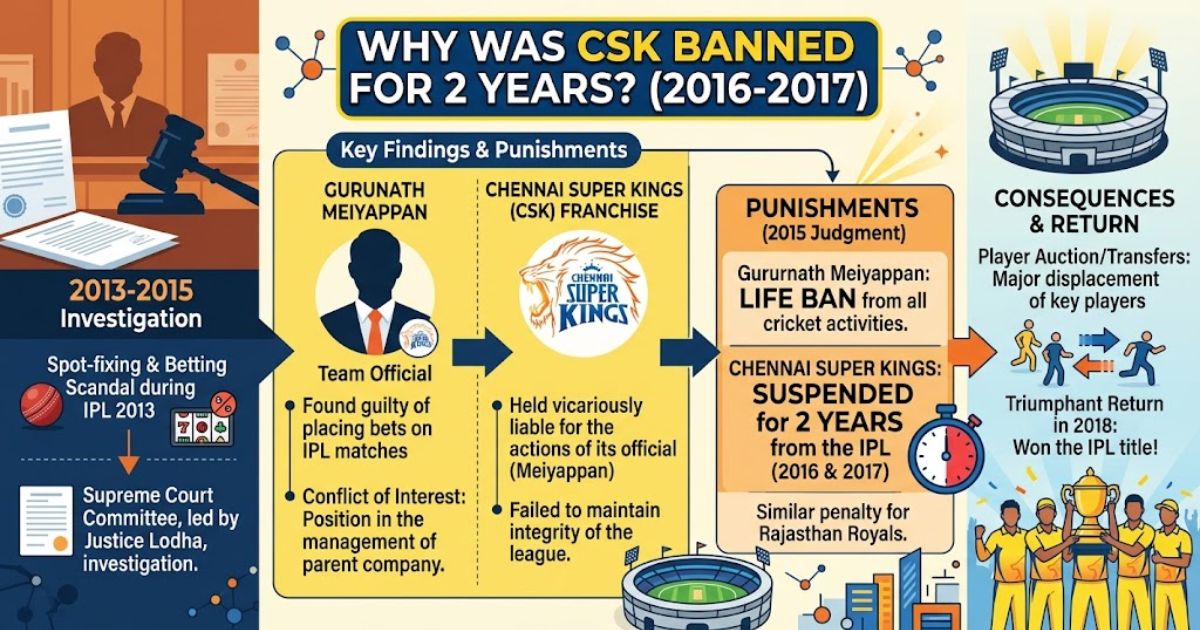

The question why CSK banned for 2 years still attracts cricket fans because the story sits at the heart of one of the biggest controversies in Indian Premier League history. Chennai Super Kings, one of the IPL’s most recognizable franchises, suddenly disappeared from the competition for the 2016 and 2017 seasons. The CSK 2 year ban wasn’t a simple punishment handed to players after a match-fixing charge. It followed a much wider investigation into betting, team officials, franchise responsibility, and the governance of the IPL. At the center of the CSK-related proceedings was Gurunath Meiyappan, who the BCCI had identified as a member of the CSK team management in 2013.
The most accurate answer to why CSK was banned for 2 years is that the Supreme Court-appointed Lodha Committee imposed a two-season suspension on CSK after proceedings concerning Meiyappan’s betting-related misconduct and the franchise’s responsibility under the IPL framework. The official BCCI record confirms that CSK and Rajasthan Royals remained suspended for two years and that replacement teams would take their places in the IPL 2016 and IPL 2017 seasons. It is important not to reduce the entire case to the statement that every CSK player fixed matches. The investigation established betting-related misconduct involving a CSK team official, while the broader allegations of fixing involved separate questions and proceedings. That distinction is the key to understanding the CSK ban controversy properly.
CSK 2 Year Ban Reason
The central CSK ban reason goes back to the 2013 betting controversy involving Gurunath Meiyappan. During the controversy, the BCCI identified Meiyappan as a member of the Chennai Super Kings team management and suspended him from all cricket-related involvement pending investigation. The BCCI’s own announcement stated that Meiyappan was an accredited team official and was subject to the IPL Operational Rules and BCCI Anti-Corruption Code. That point became extremely important because the case was not simply about an unrelated person placing bets. The proceedings examined whether a person connected to the franchise had acted in a way that violated cricket’s integrity rules and whether the franchise could be held responsible for that conduct. In other words, the reason behind CSK ban involved both the conduct of a team official and the franchise’s obligations under the IPL system.
The Supreme Court’s proceedings later paved the way for a committee headed by Justice R.M. Lodha to determine the punishment for Meiyappan and the associated franchise. A Supreme Court order specifically directed the committee to determine the punishment for Gurunath Meiyappan, Raj Kundra, and their respective franchises, teams, and owners. The eventual CSK suspension therefore came through a formal disciplinary process rather than an ordinary IPL administrative decision. This is why the CSK IPL ban is best understood as a franchise-level disciplinary action connected to the 2013 scandal. The CSK Banned story was therefore about franchise accountability as well as individual misconduct.
What Was Gurunath Meiyappan Accused Of?
Gurunath Meiyappan became the key CSK figure in the case after the investigation found his role as a CSK team official and his involvement in betting to be established. Contemporary reporting on the Mudgal Committee proceedings stated that Meiyappan’s role as a CSK official and allegations of betting and passing information had been proved, while allegations of fixing required further investigation. This difference matters. Gurunath Meiyappan betting became a central part of the case, but betting and match fixing aren’t identical terms. Betting means wagering on a sporting event or its outcomes, while fixing involves deliberately manipulating sporting events or incidents for an improper purpose. The case therefore needs to be discussed carefully rather than treating every allegation as proof that CSK players deliberately fixed matches.
Was CSK Banned Because of Match-Fixing?
The simplest answer is that the Chennai Super Kings ban should not be described as proof that the entire team fixed matches. The Mudgal Committee reporting specifically distinguished the proven betting and information-related allegations involving Meiyappan from fixing allegations that required further investigation. The later franchise punishment came through the Lodha Committee’s disciplinary process. Therefore, when readers search “Was CSK banned for fixing?”, the more accurate explanation is that the franchise was suspended following proceedings connected to betting-related misconduct by its team official and the franchise’s responsibilities under the IPL framework. That distinction makes the CSK ban explained in a way that matches the documented record rather than repeating an oversimplified version of the story.
Read More: Henry Ruggs Age: How Old Is Henry Ruggs in 2026?
IPL 2013 Betting Scandal Explained
The IPL 2013 betting scandal changed the way Indian cricket looked at integrity, betting, and the relationship between franchises and their officials. The controversy involved allegations of betting and spot fixing that attracted investigations from cricket authorities, police agencies, and eventually the Supreme Court of India. The IPL betting scandal became particularly serious because the IPL had grown into one of India’s biggest sporting competitions, making confidence in fair competition essential. The IPL spot fixing scandal also created a wider debate about whether players, team officials, owners, administrators, and other people connected with franchises were being monitored strongly enough. The BCCI’s 2013 action against Meiyappan demonstrated that the governing body considered him subject to its anti-corruption rules because of his status as a team official.
The investigation developed into a major IPL fixing scandal and cricket betting controversy involving several people and institutions. The Mudgal Committee report became particularly important because it examined the allegations and supplied material that later featured in Supreme Court proceedings. The Supreme Court subsequently appointed the Justice Lodha Committee to determine punishment for Meiyappan, Raj Kundra, and their respective franchises. This created a chain that explains the CSK ban 2015: allegations in IPL 2013, investigations involving the Mudgal Committee, Supreme Court proceedings, the Lodha Committee verdict, and finally the IPL suspension 2015 that kept CSK out of the competition for two seasons.
What Was the IPL 2013 Betting Controversy?
The 2013 IPL scandal centered on allegations that individuals connected with the competition had engaged in prohibited betting and related conduct. It is useful to understand three terms here: betting, spot fixing, and match fixing. Betting involves wagering money on a sporting event or specific outcome. Spot fixing involves manipulating a particular event inside a match, such as a delivery or another agreed incident. Match fixing is broader and involves deliberately manipulating the outcome or course of a match. These concepts can overlap in a scandal, but they aren’t interchangeable. The IPL anti-corruption investigation therefore examined different allegations separately rather than treating every betting allegation as automatic proof of match fixing.
The Role of Gurunath Meiyappan in the Scandal
The Meiyappan CSK connection became central because the BCCI officially described him as a CSK team management member when it suspended him in May 2013. Later proceedings also examined the extent of his role within the franchise. Contemporary reporting on the Mudgal Committee said the committee regarded Meiyappan as a CSK team official and found the betting and information-related allegations against him proved. That made the issue more serious than an allegation involving an ordinary spectator. The controversy raised questions about CSK team official betting, franchise oversight, the relationship between India Cements, the franchise structure, and the responsibilities of people associated with a professional cricket team.
Lodha Committee Decision and Ban
The Lodha Committee was a three-member committee headed by former Chief Justice of India R.M. Lodha, with former Supreme Court judges Ashok Bhan and R.V. Raveendran as members. The Supreme Court gave this committee responsibility for determining the punishment involving Meiyappan, Raj Kundra, and their respective franchises. This is why searches for RM Lodha Committee, Supreme Court IPL committee, and Lodha Committee CSK ban decision all lead back to the same crucial stage of the story. The committee wasn’t simply another BCCI panel. It operated as a Supreme Court appointed committee within the proceedings surrounding the IPL controversy.
The final disciplinary consequences included a two-year suspension for CSK and Rajasthan Royals. BCCI later recorded that its Working Committee would implement the Justice Lodha Committee’s interim report fully and that the two franchises would remain suspended for two years, with replacement teams invited for IPL 2016 and IPL 2017. The decision became the defining moment in the CSK ban verdict, CSK ban decision, and CSK disciplinary action. It also established a powerful example of IPL franchise accountability: misconduct connected with a franchise official could produce consequences for the franchise itself. This concept is sometimes discussed as vicarious liability in IPL, although the precise legal and disciplinary basis should be understood from the relevant orders and franchise rules rather than treated as a simple criminal-law principle.
Why Did the Lodha Committee Suspend CSK?
The suspension followed the committee’s consideration of the misconduct connected with Meiyappan and the franchise’s obligations. Contemporary reporting of the committee’s findings stated that Meiyappan’s role as a CSK official and his betting-related conduct had been established. The Lodha Committee verdict therefore had consequences beyond Meiyappan personally. The committee considered the franchise-level implications and imposed the CSK franchise punishment that removed the team from the IPL for two seasons. The case became a major example of franchise owner responsibility, cricket governance, and the principle that a professional sports franchise must maintain appropriate standards around officials connected with its operations.
Why Was the Ban Two Years?
The two-year period was the disciplinary suspension imposed on CSK and Rajasthan Royals. BCCI’s October 2015 announcement clearly stated that the franchises would remain suspended for two years and that replacement teams would participate in the IPL during 2016 and 2017. Therefore, the CSK two year suspension wasn’t a criminal prison sentence or a ban on every CSK player from playing cricket. It was a two-season suspension of the franchise from the IPL. This explains the frequently searched phrase CSK suspension years and confirms that the CSK ban 2016 2017 covered those two IPL seasons. The CSK Banned period was consequently tied to the franchise’s participation in the league rather than a blanket prohibition on its players appearing in professional cricket.
CSK Ban Timeline
The CSK ban timeline stretches from the 2013 controversy through the 2018 return. The story didn’t begin with the final punishment in 2015. It developed through investigation, committee reports, Supreme Court proceedings, and disciplinary action. Looking at the sequence makes the history of CSK ban much easier to understand because each stage answered a different question.
| Date/Year | Event | Importance |
|---|---|---|
| 2013 | IPL betting and spot-fixing controversy emerges | The investigation begins |
| May 2013 | BCCI suspends Gurunath Meiyappan | BCCI identifies him as a CSK team-management member |
| 2013–2014 | Investigations and Mudgal Committee proceedings | Allegations involving betting and fixing are examined |
| 2014–2015 | Supreme Court proceedings continue | The case moves into a wider judicial process |
| 2015 | Lodha Committee determines punishment | CSK receives a two-year franchise suspension |
| 2016 | CSK misses IPL 2016 | First season of the suspension |
| 2017 | CSK misses IPL 2017 | Second and final season of the suspension |
| July 2017 | BCCI welcomes CSK back | Two-year suspension is completed |
| 2018 | CSK returns to IPL | Franchise plays again and wins the 2018 title |
The timeline explains when was CSK banned, when did CSK get banned, and which years CSK was banned. BCCI’s 2013 announcement confirms Meiyappan’s suspension, while BCCI’s 2015 record confirms that CSK and Rajasthan Royals were suspended for two years. In July 2017, BCCI formally announced that both franchises had completed their two-year suspensions and would return for the 2018 IPL. The CSK ban year is therefore commonly associated with 2015, while the actual seasons missed were IPL 2016 and IPL 2017.
What Happened to CSK Players During the Ban?
The CSK players during ban period didn’t receive a two-year ban simply because they had played for CSK. Instead, many members of the old CSK group continued playing IPL cricket through the replacement franchises. This is one reason the story can be confusing for fans. CSK itself wasn’t in the competition, yet familiar names remained on the IPL field. The 2016 player draft assigned MS Dhoni to the Pune franchise, while Suresh Raina and Ravindra Jadeja went to the Rajkot franchise. Ravichandran Ashwin and Faf du Plessis were among the players selected by Pune, while Dwayne Bravo joined the Rajkot side. This explains what happened to CSK players 2016 and why the CSK players moved to Rising Pune Supergiant and CSK players moved to Gujarat Lions during the suspension.
The 2017 IPL retained many of those connections. The official IPL retention list shows MS Dhoni, R. Ashwin, and Faf du Plessis with Rising Pune Supergiant, while Suresh Raina, Ravindra Jadeja, and Dwayne Bravo were with Gujarat Lions. So, although fans often ask about the MS Dhoni CSK ban, Dhoni himself wasn’t barred from playing IPL cricket simply because CSK was suspended. He represented Pune during the two-season period. The same applies to several other major CSK names. The franchise suspension and individual player eligibility were separate matters.
Where Did CSK Players Play During 2016 and 2017?
During the suspension, the IPL introduced two replacement franchises: Rising Pune Supergiant and Gujarat Lions. The player draft placed MS Dhoni, R. Ashwin, and Faf du Plessis with Pune, while Suresh Raina, Ravindra Jadeja, and Dwayne Bravo were among the familiar CSK names associated with Gujarat. The official IPL records from 2016 and 2017 repeatedly show these players competing for the replacement teams. This arrangement allowed players to continue their careers while the CSK franchise suspension remained in force.
Impact of CSK Ban on IPL
The Chennai Super Kings two year ban had a major effect on the structure and story of the IPL. For two seasons, the competition operated without CSK and Rajasthan Royals, two established franchises. BCCI therefore invited bids for two replacement teams for 2016 and 2017. Those teams became Rising Pune Supergiant and Gujarat Lions, creating a temporary IPL landscape in which well-known CSK players appeared under different colours. The IPL franchise suspension also forced the league to confront difficult questions about governance, integrity, and how much responsibility should fall on a franchise when misconduct involves someone connected with its management.
The wider impact went beyond the league table. The episode became part of the debate over cricket corruption, cricket governance, conflict of interest, IPL governance reforms, and anti-corruption measures. BCCI stated after the Lodha Committee order that it was committed to transparency, accountability, and restoring confidence in cricket and the IPL. The case therefore became a reference point for discussions about IPL anti-corruption rules, BCCI anti-corruption code, cricket integrity, sports corruption, and disciplinary action. It also demonstrated how a sports competition can face reputational damage when questions arise around officials, owners, betting, and regulatory oversight.
Impact on CSK Fans and Franchise Identity
For supporters, the CSK ban controversy was unusual because the team’s identity remained strong even while the franchise itself disappeared from the IPL. Fans watched familiar stars such as Dhoni, Raina, Jadeja, Bravo, and Ashwin play for other teams. The 2016 player draft officially placed Dhoni with Pune and Raina with Rajkot, making the split visible from the first season of the suspension. The absence also created a powerful contrast between the franchise’s earlier IPL presence and its sudden two-season break. That period is why searches such as why CSK missed IPL, what happened to CSK in 2016, and what happened to CSK in 2017 remain common among newer cricket fans.
Why CSK Banned for 2 Years Still Matters Today
The answer to why CSK banned for 2 years still matters because the episode illustrates how modern sports organizations deal with integrity problems. The case wasn’t only about one person placing bets. It raised questions about how closely franchises should monitor officials, how anti-corruption rules should work, and whether the actions of a team representative can create consequences for the wider franchise. The Supreme Court’s process ultimately placed the punishment question before the Lodha Committee, which was specifically asked to determine consequences for Meiyappan, Raj Kundra, and their respective franchises. That structure makes the CSK IPL ban explained more complicated than a simple headline about a cricket team being caught fixing matches.
The episode also remains relevant because online discussions often mix together the CSK betting scandal, IPL betting scandal, IPL corruption controversy, and allegations of match fixing. Those terms describe related but different issues. The Mudgal Committee reporting distinguished proven betting and information-related allegations involving Meiyappan from fixing allegations that required further investigation. That is why the CSK Banned narrative should always explain the evidence and the disciplinary process rather than using one broad label for every allegation. For Indian cricket, the case remains an important part of the history of IPL anti-corruption investigation, IPL disciplinary action, and franchise accountability.
What the CSK Ban Taught the IPL
The biggest lesson from the CSK ban explained is that professional sports depend on more than what happens between the boundary ropes. Team officials, franchise management, owners, administrators, players, and regulators all have responsibilities. The CSK case brought concepts such as vicarious liability in IPL, franchise owner responsibility, IPL franchise accountability, and conflict of interest in cricket into wider public discussion. It also showed why strong anti-corruption measures matter in a league where enormous commercial interests can surround every match.
CSK Comeback After 2-Year Ban
The CSK return 2018 marked the end of the two-season absence. In July 2017, the BCCI officially welcomed Chennai Super Kings and Rajasthan Royals back into the IPL and confirmed that both had completed the two-year suspension imposed by the Supreme Court-appointed Justice Lodha Committee. That announcement effectively closed the suspension chapter and began preparations for the 2018 season. For fans searching when CSK returned after two year ban, the answer is the IPL 2018 season. The franchise returned with its familiar identity, while many of its most recognizable players were again associated with CSK.
The return quickly became one of the most memorable chapters in the franchise’s history. CSK reached the 2018 final and defeated Sunrisers Hyderabad by eight wickets at Mumbai’s Wankhede Stadium to win the title. Shane Watson scored an unbeaten 117, while Suresh Raina contributed 32 in the chase. The result gave the CSK comeback after ban an immediate sporting conclusion. Official IPL records described it as CSK’s third IPL title, with MS Dhoni leading the side. Thus, the CSK 2018 comeback wasn’t simply a return to the fixture list. It became a major part of the league’s modern history.
When Did CSK Return to the IPL?
CSK returned to the IPL in 2018 after missing the 2016 and 2017 seasons. BCCI announced in July 2017 that CSK and Rajasthan Royals had completed their two-year suspensions and would participate in the next edition of the league. The 2018 season then provided the franchise with its return to competitive IPL cricket. CSK won the final against Sunrisers Hyderabad by eight wickets and secured its third IPL championship at the time. The CSK Banned period was therefore complete before the 2018 competition began.
Conclusion
So, why Chennai Super Kings banned for two years? The answer traces back to the 2013 IPL controversy and the conduct of Gurunath Meiyappan, who the BCCI identified as a CSK team-management member and who became central to the betting investigation. The Mudgal Committee’s findings distinguished betting and information-related allegations from fixing allegations that required further investigation. The Supreme Court then placed the punishment question before the Lodha Committee, which ultimately imposed a two-year suspension on CSK and Rajasthan Royals. BCCI confirmed that CSK would miss IPL 2016 and IPL 2017. This is the clearest CSK ban full story and explains the reason for CSK suspension without confusing betting with proven match fixing.
The CSK ban timeline 2013 to 2018 can therefore be remembered simply: controversy and investigation in 2013, judicial and committee proceedings afterward, the CSK ban 2015, absence during IPL 2016 and IPL 2017, and the CSK return after suspension in 2018. BCCI officially confirmed the return, and CSK then won the 2018 IPL final against Sunrisers Hyderabad. The CSK Banned chapter ultimately became a significant part of IPL history because it raised lasting questions about cricket governance, franchise accountability, anti-corruption rules, and the responsibilities of people working inside professional sports.
FAQ’s
Why CSK got banned for 2 years?
CSK received a two-year franchise suspension following proceedings connected with Gurunath Meiyappan, a CSK team official whose betting-related conduct became central to the 2013 IPL controversy. The Supreme Court-appointed Lodha Committee was tasked with determining punishment involving Meiyappan and the associated franchise. The BCCI later confirmed that CSK and Rajasthan Royals would remain suspended for two years and that replacement teams would participate in 2016 and 2017. This is the documented why was CSK banned for 2 years explanation.
What is match-fixing in IPL?
Match fixing means deliberately manipulating a match or its result for an improper purpose, often connected with financial gain. Spot fixing is narrower and can involve manipulating a particular event within a match. Betting involves placing a wager on a sporting event or outcome. These terms often appear together when discussing the IPL scandal, but they don’t mean exactly the same thing. In the CSK-related proceedings, contemporary reporting on the Mudgal Committee distinguished proven betting and information-related allegations against Meiyappan from fixing allegations that required further investigation.
Why was RCB banned for 2 years?
Royal Challengers Bengaluru, formerly known as Royal Challengers Bangalore, was not one of the IPL franchises suspended for two years in the 2015 Lodha Committee decision. The two franchises suspended were Chennai Super Kings and Rajasthan Royals. BCCI’s official announcement specifically stated that CSK and RR would remain suspended for two years and that two replacement teams would be used for the 2016 and 2017 IPL seasons. Therefore, the common search query “Was RCB banned for two years?” is based on a misconception.
Why was CSK banned for 2 years on Wikipedia?
Wikipedia provides a secondary summary of the historical case, but it shouldn’t be the only source used to understand the legal or disciplinary reasoning. The primary record is more useful when checking why CSK was suspended from IPL for two years, because BCCI records and Supreme Court documents show the progression from the 2013 investigation to the committee process and the eventual franchise suspension. The Supreme Court order specifically assigned the Lodha Committee the task of determining punishment involving Meiyappan, Raj Kundra, and their respective franchises.
Was CSK banned for fixing?
The most accurate answer is that CSK was suspended following disciplinary proceedings connected with betting-related misconduct involving its team official Gurunath Meiyappan. It is too simplistic to say that the suspension itself proved that every CSK player or the entire franchise had fixed matches. The Mudgal Committee reporting stated that Meiyappan’s role as a CSK team official and his betting and information-related conduct were established, while fixing allegations required further investigation. The CSK Banned case therefore needs to be described using the specific findings rather than the broad claim that CSK players were all involved in match fixing.
Why was Chennai Super Kings banned for 2 years?
The Chennai Super Kings ban followed the disciplinary process surrounding Gurunath Meiyappan’s betting-related conduct and the responsibilities of the franchise. The Supreme Court appointed the Lodha Committee to determine punishment involving Meiyappan and the CSK franchise. BCCI then confirmed the two-year suspension covering the 2016 and 2017 IPL seasons. This is the documented why Chennai Super Kings got banned explanation.
Who banned CSK from IPL?
The punishment was imposed through the Justice Lodha Committee, which had been appointed by the Supreme Court of India to determine the appropriate punishment in the matter. The BCCI subsequently implemented the decision and officially recorded CSK’s two-year suspension. This is why the Lodha Committee, Supreme Court of India, and BCCI CSK suspension are all important parts of the case.
When was CSK banned?
The decisive franchise suspension came in 2015. BCCI’s October 2015 record confirmed that CSK and Rajasthan Royals remained suspended for two years and would be replaced during the 2016 and 2017 IPL seasons. The controversy itself began earlier, during IPL 2013, so CSK ban 2015 refers to the disciplinary decision rather than the beginning of the scandal.
Which years was CSK banned?
CSK missed IPL 2016 and IPL 2017. BCCI explicitly stated that the two franchises would be replaced for those two seasons. Therefore, when readers ask which years CSK was banned, CSK suspension years, or why CSK did not play IPL 2016 and 2017, the answer is 2016 and 2017.
Was CSK involved in match fixing?
The documented proceedings require a distinction between betting and fixing. The Mudgal Committee reporting said Meiyappan’s role as a CSK official and his betting and information-related conduct were established, while allegations of fixing required further investigation. Therefore, saying simply that the entire CSK team was involved in match fixing would go beyond what those findings establish.
What was the CSK betting scandal?
The CSK betting scandal centered on Gurunath Meiyappan, whom the BCCI identified as part of CSK’s team management in 2013. He was suspended by the BCCI after his detention by Mumbai Police and was made subject to the IPL Operational Rules and BCCI Anti-Corruption Code. Subsequent investigations and Supreme Court proceedings examined the matter, eventually leading to the Lodha Committee’s disciplinary process and the two-year franchise suspension.
Who was Gurunath Meiyappan?
Gurunath Meiyappan was associated with Chennai Super Kings as a team official. The BCCI identified him as a member of the CSK team management when it announced his suspension in May 2013. His betting-related conduct became central to the IPL controversy and eventually to the disciplinary proceedings that resulted in CSK’s two-season suspension.
What did the Lodha Committee decide?
The committee determined disciplinary consequences involving the CSK and Rajasthan Royals franchises after considering the proceedings concerning Meiyappan and Raj Kundra. BCCI subsequently confirmed that both franchises would remain suspended for two years and that replacement teams would participate in IPL 2016 and IPL 2017. The decision became the central CSK ban verdict in the franchise’s history.
Why were CSK and RR banned?
CSK and Rajasthan Royals were both connected to officials whose conduct became part of the IPL betting controversy. The Supreme Court appointed the Lodha Committee to determine punishment for Gurunath Meiyappan, Raj Kundra, and their respective franchises. BCCI later confirmed the two-year suspension of both franchises. This explains the CSK and Rajasthan Royals ban and the Rajasthan Royals two year ban.
Did CSK players get banned?
The franchise received the two-season suspension, but that didn’t mean all CSK players were personally banned from playing cricket. During the suspension, major CSK players were drafted by the replacement franchises. The official 2016 player draft, for example, placed MS Dhoni, Ravichandran Ashwin, and Faf du Plessis with Pune, while Suresh Raina, Ravindra Jadeja, and Dwayne Bravo went to Rajkot. This explains what happened to CSK players during ban.
What happened to CSK players during the ban?
Many familiar players continued their IPL careers with Rising Pune Supergiant and Gujarat Lions. The official 2017 retention list confirms MS Dhoni with Pune and Suresh Raina, Ravindra Jadeja, and Dwayne Bravo with Gujarat. So the CSK suspension affected the franchise’s participation, while eligible players could continue competing for other IPL teams.
When did CSK return to IPL?
CSK returned for the 2018 IPL season after completing its two-year suspension. BCCI announced in July 2017 that CSK and Rajasthan Royals had completed their suspensions and would return to the league. CSK then won the 2018 IPL final against Sunrisers Hyderabad by eight wickets. This became the defining moment of the CSK comeback after two-year suspension.
Did CSK win IPL after returning?
Yes. CSK won the 2018 IPL after returning from its two-season absence. In the final at Wankhede Stadium, CSK defeated Sunrisers Hyderabad by eight wickets, with Shane Watson scoring an unbeaten 117. The official IPL record described it as CSK’s third IPL title at that time.
Why was Rajasthan Royals also banned?
Rajasthan Royals received a two-year franchise suspension through the same broader disciplinary process. The Supreme Court had directed the Lodha Committee to determine punishment involving Raj Kundra and his associated franchise, just as it did for Meiyappan and CSK. BCCI subsequently confirmed the suspension of both franchises for 2016 and 2017.
Was RCB banned for two years?
No. RCB was not one of the two franchises suspended in the 2015 decision. The affected franchises were CSK and Rajasthan Royals. BCCI’s official announcement specifically identified those two teams and stated that replacement teams would operate during the 2016 and 2017 seasons.
What happened to CSK in 2016 and 2017?
CSK did not participate in either season because its two-year franchise suspension covered IPL 2016 and IPL 2017. Replacement franchises took part instead, and several CSK stars were distributed between those teams. The official IPL player draft confirms that Dhoni, Ashwin, and Faf du Plessis went to Pune, while Raina, Jadeja, and Bravo went to Rajkot. In 2018, CSK returned and won the IPL title.

Magazine Scop Editorial Team researches celebrity and entertainment topics using reputable public sources. We prioritize factual accuracy, transparent sourcing, and clear corrections whenever reliable information is limited or disputed.
