
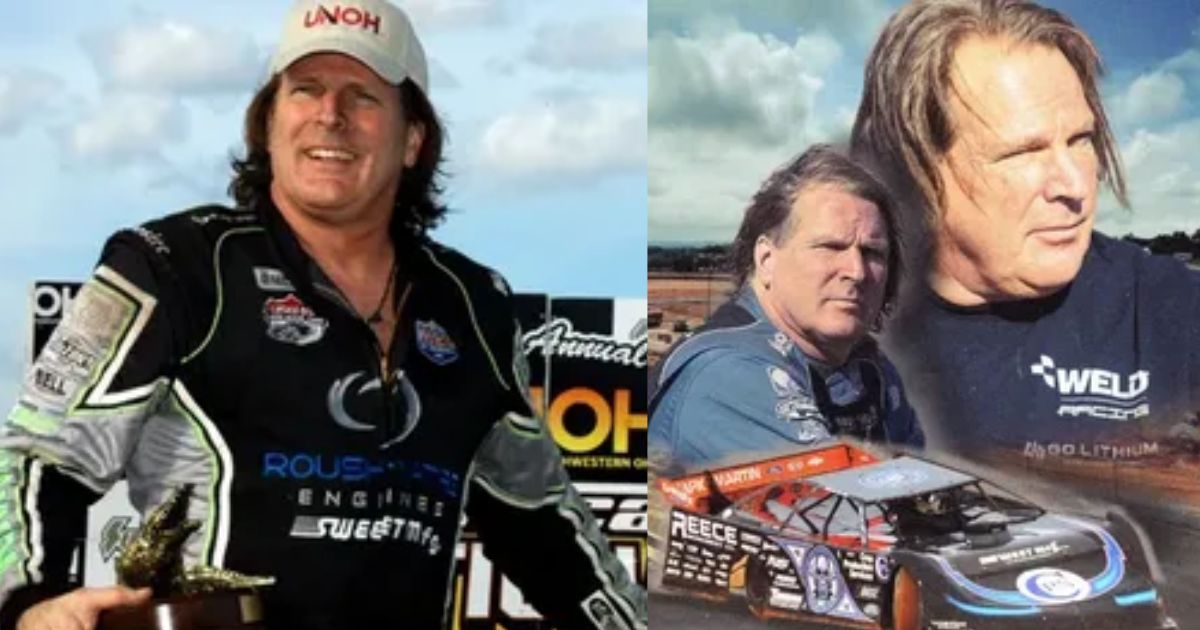

There are drivers who win races. Then there are drivers who change the sport entirely. Scott Bloomquist belonged firmly in the second category. From the packed red clay of Mooresburg, Tennessee to the legendary grounds of Eldora Speedway, he didn’t just compete — he dominated, innovated, and rewrote what was possible inside a dirt late model car. People across the American motorsports world still talk about him in the present tense, as though he might show up this Saturday night and put on a clinic. The question everyone asks — what was the Scott Bloomquist Net Worth heading into 2026? — deserves a thorough, honest answer. And that’s exactly what this article delivers.
Who is Scott Bloomquist?
Ask any serious dirt track racing fan to name the greatest late model driver who ever lived and Scott Bloomquist’s name comes up almost immediately. He was the kind of competitor that made a whole generation of racers feel inadequate and inspired at the same time. Over a career that stretched from 1980 all the way to 2024, he racked up more than 600 victories, nine national championships, and a reputation for engineering genius that rivaled his reputation behind the wheel. He was a racing innovator, a motorsports entrepreneur, and a man who treated the Lucas Oil Late Model Dirt Series and the World of Outlaws Late Model Series like personal playgrounds.
What separates Scott Bloomquist’s racing career from virtually everyone else in the game is the sheer breadth of it. He wasn’t great for a season or a decade. He was great for four decades. He won championships in the 1990s, dominated in the 2000s, and still had the speed and savvy to take a Lucas Oil Late Model Dirt Series crown in 2016. Combine that longevity with his chassis manufacturing empire through Team Zero Race Cars, his sponsorship income, and his relentless racing earnings, and the picture of the Scott Bloomquist Net Worth starts to come into sharp focus.
Scott Bloomquist Bio
Scott Bloomquist — born Scott Dean Bloomquist on November 14, 1963, in Fort Dodge, Iowa — spent 44 years building one of the most decorated careers in dirt racing history. He relocated to Mooresburg, Tennessee early in his adult life and made that farm community his base of operations for everything: his racing team, his Team Zero Race Cars business, and his personal life. He was inducted into the National Dirt Late Model Hall of Fame in 2002, when his career still had well over a decade of elite-level performance left in it. He passed away on August 16, 2024, at the age of 60, leaving behind a racing legacy that the sport will feel for generations.
His father was both a pilot and a stock car racing enthusiast — a combination that essentially preordained Scott’s twin passions for speed on the ground and freedom in the air. Racing wasn’t something he stumbled into. It was something his family planted in him, nurtured deliberately, and watched grow into something far beyond what anyone could have predicted at the start.
Quick Facts
| Detail | Information |
|---|---|
| Full Name | Scott Dean Bloomquist |
| Date of Birth | November 14, 1963 |
| Birthplace | Fort Dodge, Iowa, USA |
| Date of Death | August 16, 2024 |
| Place of Death | Mooresburg, Tennessee, USA |
| Age at Death | 60 years |
| Nationality | American |
| Profession | Dirt late model driver, Chassis Builder, Race team owner |
| Nicknames | “The King,” “The Godfather of the Dirt,” “Voodoo Child” |
| Scott Bloomquist Net Worth | ~$21 Million (estimated, 2026) |
Scott Bloomquist Personal Details
At 6 feet 1 inch tall and built with the kind of athletic frame that suggested someone who took physical preparation seriously, Scott Bloomquist cut an imposing figure long before he ever climbed into a race car. His height gave him presence. His record gave him authority. Combined, the two made him one of the most recognizable personalities in the entirety of competitive motorsports — not just on the dirt late model circuit.
Scott Bloomquist’s age when he died was 60, though anyone who watched him race in his final active seasons would tell you he moved and thought like someone a decade younger. Born in 1963 to Ron Bloomquist and Georgie Bloomquist, he was raised in a home where ambition and mechanical curiosity were standard parts of the daily atmosphere. He completed high school but found his true education in garages and on racetracks, absorbing the science of race car engineering through hands-on experimentation that no classroom curriculum could have replicated.
| Personal Stat | Details |
|---|---|
| Height | 6 feet 1 inch |
| Build | Athletic |
| Education | High School Graduate |
| Father | Ron Bloomquist |
| Mother | Georgie Bloomquist |
| Primary Residence | Mooresburg, Tennessee |
| Secondary Passion | Aviation |
Scott Bloomquist Wife And Family
The name Katrina Rouse Bloomquist is inseparable from the Scott Bloomquist story. They met when both were around 18 years old, and what started as a young romance became a decades-long partnership that survived the grueling rhythms of a professional racing career — the constant travel, the relentless pressure, the physical danger that comes with driving at the limit every single weekend. She was at the track for countless wins, and she was there through the setbacks too.
Together, Scott and Katrina Rouse raised their daughter Ariel Bloomquist, born on March 1, 2006, in Fort Dodge, Iowa. Ariel grew up trackside, absorbing her father’s world by proximity if not by profession. For Scott, she represented everything that mattered beyond trophies and prize checks. The two parents eventually divorced — a split described by those close to the family as genuinely painful — but the bond forged through shared years of racing life never entirely dissolved.
After Scott’s death, Katrina responded with quiet dignity. She took to social media to share photographs from his early racing years, preserving memories for the vast community of dirt racing fans who admired him. One of those photos showed a young, grinning Scott in full racing gear at Bulls Gap Motor Speedway — clear evidence that the passion started young and the love story started right alongside it.
Read More: Lil Uzi Vert: Untold Story, Real Name, Career Journey & Latest Updates Revealed
Scott Bloomquist Early Life and Background
Long before he was “The King” of dirt late model racing, Scott Bloomquist was just a kid from Fort Dodge, Iowa with an engine in his driveway and ambition that wouldn’t sit still. His family background was deeply rooted in motorsports. His father — a stock-car enthusiast and licensed pilot — gave young Scott a Chevy, an engine, and a set of tires as an early racing starter kit. That gift set everything in motion.
The family eventually relocated to California, where Scott threw himself into local racing with the kind of focus that teenagers usually reserve for other pursuits. He made his competitive debut at Corona Raceway in August 1980. By 1982, he’d already claimed a local track championship — impressive for a teenager, genuinely extraordinary when you consider what that winning habit would eventually grow into. Chula Vista Speedway was another early proving ground, a place where Scott refined the instincts that would later make him nearly impossible to beat at the elite level.
His personal background shaped everything about his approach to the sport. Racing in the Bloomquist family wasn’t treated casually — it was treated as something worthy of total dedication. That ethos traveled with him when he eventually settled in Mooresburg, Tennessee, where he built his farm, his airstrip, his garage, and the business empire that would eventually become the other half of his legacy. Iowa gave him his roots. Tennessee gave him his kingdom.
Scott Bloomquist Career
Trying to summarize Scott Bloomquist’s racing career in a few paragraphs is a bit like trying to summarize a novel in a sentence. The broad strokes are spectacular enough — 600-plus wins, nine national championships, four-plus decades of elite-level performance — but the real texture of his career lives in the details. The way he set up a car differently than everyone else. The way he could read a changing track surface and adapt mid-race. The way he won races in conditions that made other drivers grateful just to finish.
Career Beginnings and Key Milestones
Scott kicked off his racing career at Corona Raceway in 1980 and had already locked up a local track championship by 1982. Those early wins weren’t flukes. They were evidence of something real. He pushed steadily toward the bigger circuits, and by the mid-1980s he was competing for attention on the national dirt late model stage with a style that was immediately recognizable: calculated aggression, flawless car preparation, and an ability to avoid the kind of mistakes that cost other talented drivers races they should have won.
The World 100 at Eldora Speedway was one of his early signature victories — a win that announced to the national audience that Scott Bloomquist wasn’t a regional story anymore. His induction into the National Dirt Late Model Hall of Fame in 2002 came as a second-class honoree, putting him among the most elite names the sport had ever produced. What made that recognition remarkable was that it arrived while he was still actively competing at the highest level, with some of his most dominant seasons still ahead of him.
Scott Bloomquist Racing Winnings
Scott Bloomquist’s earnings from race purses represent one of the most impressive financial tallies in dirt track racing history. His peak earning years — roughly 2003 through 2016 — produced a stream of big-money victories that stacked up into a truly substantial career total. In 2010 alone, he reportedly earned over $242,000 from various race events. That kind of single-season production, repeated across more than a decade of elite competition, built the foundation of the Scott Bloomquist Net Worth one race at a time.
Specific event victories added major chunks to that total. The 2006 Dirt Late Model Dream at Eldora Speedway paid him $100,000. The Cedar Lake Nationals added $50,000. The Topless 100 brought in $45,000, while the Scorcher and Racefast events each contributed $20,000. These weren’t once-in-a-career paydays — they were the kind of results Scott produced repeatedly across multiple seasons, year after year, at the sport’s biggest and most lucrative events.
| Event | Estimated Prize |
|---|---|
| 2006 Dirt Late Model Dream | $100,000 |
| Cedar Lake Nationals | $50,000 |
| Topless 100 | $45,000 |
| Scorcher 100 | $20,000 |
| Racefast | $20,000 |
| 2010 Full Season | $242,000+ |
| Total Career Race Earnings | ~$10–15 Million |
Championships and Series Titles
Nine national championships. That number alone sets Scott Bloomquist apart from virtually every other dirt late model competitor who ever strapped in. His titles spanned multiple series and multiple decades — proof that his excellence wasn’t a product of one dominant era but a consistent, sustained force across the entire arc of dirt racing history.
He captured the World of Outlaws Late Model Series championship in 2004. He won the Lucas Oil Late Model Dirt Series in 2009, 2010, and 2016. He dominated the Hav-A-Tampa Dirt Late Model Series in 1994, 1995, 1998, and 2000. On top of those, he won The Dream at Eldora Speedway nine times, the World 100 four times, and the Blue-Gray 100 on four separate occasions. Each of those marquee events represents a massive purse, enormous prestige, and another notch in a championship record that no dirt late model driver in history has matched.
Career Victories
More than 600 feature wins. The number is almost surreal when you hold it up against the dirt racing context. These aren’t small-town heat races padding a stat line — these are feature events at legitimate, competitive dirt track racing venues across America, against other elite professional drivers who were themselves trying their hardest to win. Scott beat them anyway. Over and over and over again.
His 94 wins in the Lucas Oil Late Model Dirt Series alone make him the all-time victories leader in that series — a record that speaks to sustained excellence over the long haul, not just a few brilliant seasons. As a racing champion who won in the 1980s, 1990s, 2000s, and 2010s, he belongs in a conversation that most motorsports legends can barely enter.
Scott Bloomquist Business Ventures
The Scott Bloomquist Net Worth tells a richer story when you factor in what he built outside the cockpit. Most professional drivers earn, spend, and eventually retire with considerably less than their peak-career income suggested they should have. Scott understood that the racing lifestyle could fuel a business infrastructure. And he built one that genuinely worked.
Scott Bloomquist Race Cars
Team Zero Race Cars was the most significant business venture of Scott Bloomquist’s career off the track. As the owner and chief engineer of this dirt late model chassis manufacturer, he turned his engineering insights into a commercial product that other teams trusted. The company designed and sold chassis to racing enthusiasts and competitive teams alike, creating a revenue stream that operated independently of whatever Scott was doing on the track on any given weekend.
He partnered with Randy Sweet from 2014 to 2019 to expand the Team Zero operation, a collaboration that deepened the company’s reach and refined its product line. The motorsports business became a respected name in competitive circles — when you bought a Team Zero chassis, you were buying the engineering philosophy of a six-hundred-win racing champion built into the steel itself.
Innovations & Business
Scott Bloomquist approached race car design with an engineer’s mind and a competitor’s obsession. He wasn’t content to simply drive what other people built. He wanted to understand every mechanical variable — how weight distribution affected cornering balance, how suspension geometry translated to traction in different track conditions, how small aerodynamic tweaks changed a car’s behavior at high speed. That understanding made him a better driver. It also made him a better businessman.
His contributions to racing technology and race car engineering helped shape the direction of the entire dirt late model industry. Teams that competed against him studied his setups. Chassis builders borrowed from his innovations. The ripple effects of his engineering work are still visible today in how competitive motorsports teams approach their car programs. Beyond Team Zero, he diversified into equipment manufacturing and event-adjacent business interests, keeping multiple income streams active at all times. Total revenue from chassis sales and related services is estimated at $5 to $7 million — a massive secondary contribution to his overall motorsports wealth.
Scott Bloomquist Achievements and Legacy
The achievements list attached to Scott Bloomquist’s biography is long enough to fill a wall at any dirt racing museum. Nine national championships. Six hundred-plus wins. Eight Dream victories at Eldora Speedway. Four World 100 titles. The 2006 RPM Racing News Driver of the Year award. Induction into the National Dirt Late Model Hall of Fame in 2002. Victories in virtually every major dirt late model event that matters. It reads like a checklist someone designed to define the ceiling of what a racing champion could possibly accomplish.
But the legacy extends well beyond the trophies and the prize money. Scott was a mentor. He invested time and attention in young talent, helping drivers like Tyler Reddick develop their skills and their confidence at a stage when those resources can make the difference between a career that sticks and one that fades. Reddick went on to become a NASCAR Cup Series competitor — one small but meaningful piece of the human legacy Scott left behind.
His impact on racing technology is arguably even deeper than his personal accomplishments. The chassis innovations he developed through Team Zero Race Cars changed how competitive teams approached dirt late model car construction. His engineering ideas influenced chassis builders who had never worked with him directly. That’s the kind of legacy that doesn’t show up on a Wikipedia page but shapes the sport invisibly from the inside.
He also contributed to scholarship funds and supported community events at dirt track racing venues throughout his career, quietly investing in the infrastructure that keeps grassroots motorsports alive. For all his brash competitiveness and outspoken personality, Scott Bloomquist genuinely cared about the sport that made him.
Scott Bloomquist Death Incident
August 16, 2024, started like an ordinary Friday morning in rural Mooresburg, Tennessee. It did not stay that way. The dirt racing world received the shattering news that Scott Bloomquist had died in a plane crash on his family farm. A small vintage aircraft — his beloved Piper J-3 Cub — had crashed into a barn adjacent to the private airstrip on his property. He was 60 years old.
The National Transportation Safety Board launched an investigation that concluded in June 2025. Their final report ruled the crash a deliberate act of suicide. The report stated that the probable cause was the pilot’s intentional flight into a building as an act of suicide. A witness told investigators that Scott had woken him before the incident and described being told he had a serious cardiac condition — a “spot on his heart” he called a widowmaker. Scott reportedly told the man he didn’t want to die in a hospital bed.
The path to that August morning ran through a series of brutal setbacks that had tested him relentlessly. A serious motorcycle accident at Daytona Beach Bike Week in 2019 sidelined him for an extended period, leaving him with right leg and hip injuries. A prostate cancer diagnosis followed in 2023, requiring surgery. A foot injury hit before the 2023 Dirt Track World Championship at Eldora Speedway, and shoulder surgery preceded his planned return in 2024. Earlier that same summer, he suffered a severe allergic reaction to a horsefly bite serious enough to require emergency medical treatment.
The Bloomquist family issued a statement asking for privacy, confirming they were not making public comments about the crash or the NTSB findings. World Racing Group’s CEO Brian Cox spoke for many when he called Bloomquist’s loss deeply felt across the entire World of Outlaws and DIRTcar community. The tributes that followed were extraordinary in their volume and sincerity — evidence of a man who had touched the dirt racing world far more deeply than even his remarkable win total could fully express.
Scott Bloomquist Net Worth 2026
The Scott Bloomquist Net Worth as of 2026 is estimated at approximately $21 million. That figure represents the full weight of a 44-year career that combined relentless on-track success with shrewd off-track business building — making the Scott Bloomquist Net Worth one of the most impressive financial achievements in the history of dirt late model racing. He earned it through racing winnings, through sponsorship income from leading brands, through merchandise sales to a devoted fanbase, and through the sustained commercial success of Team Zero Race Cars.
A significant portion of the Scott Bloomquist Net Worth came directly from race purses — events where winning could net upwards of $100,000 in a single night. His estimated career total from racing alone runs between $10 million and $15 million. Add the $5 to $7 million attributed to chassis sales and motorsports business income, factor in sponsorship revenue and merchandise, and the road to $21 million becomes clear and logical rather than surprising.
His asset base reflected a man who invested in tangible things he loved. The Tennessee family farm. The Piper J-3 Cub airplane. A racing fleet whose value, even in storage, represented a significant portion of his wealth. He reinvested heavily back into the sport throughout his career — upgrading equipment, funding Team Zero’s innovation pipeline, and supporting young drivers — which demonstrates that the Scott Bloomquist net worth wasn’t just accumulated but continuously cycled through the sport that generated it.
Different sources offer different estimates, and the variance reflects the challenge of valuing private businesses, illiquid assets, and a racing brand whose equity is deeply personal. Conservative estimates place the figure around $4 to $5 million. More comprehensive analyses — accounting for Team Zero, brand value, and the full breadth of his career — push toward $22 to $24 million. The most credible, widely cited consensus for the Scott Bloomquist Net Worth settles at approximately $21 million, and that’s the figure that best reflects the totality of what he built.
It’s worth emphasizing that the Scott Bloomquist Net Worth didn’t happen overnight and wasn’t the product of a single lucky break. It was the result of consistent excellence sustained over four decades, combined with the vision to see that a racing career could seed a business empire if approached with the right intelligence and ambition.
Net Worth Comparison with Other Professionals
Placing the Scott Bloomquist Net Worth in context requires comparing it to others in the dirt late model racing world and the broader motorsports landscape.
| Driver / Personality | Estimated Net Worth |
|---|---|
| Scott Bloomquist | ~$21 Million |
| Tony Stewart | ~$80 Million |
| Jeff Gordon | ~$200 Million |
| Josh Richards | ~$3–5 Million |
| Brandon Sheppard | ~$1–2 Million |
| Donnie Allison | ~$3 Million |
| Mike Marlar | ~$1 Million |
Within the specific world of dirt late model racing, the Scott Bloomquist Net Worth is simply in its own tier. No other dirt late model driver has combined sustained racing success with a chassis manufacturing business and a sponsorship income portfolio to generate comparable wealth. Tony Stewart’s figure reflects his NASCAR career and ownership of multiple racing properties — a different financial scale entirely. But among dirt racing specialists, Scott stands alone.
Net Worth at the Time of Death
At the time of his passing on August 16, 2024, the Scott Bloomquist Net Worth stood at an estimated $21 million. Despite the physical challenges of his final years — the injuries, the cancer diagnosis, the surgeries — his financial position remained strong because the businesses he’d built didn’t require him to be healthy to generate income. Team Zero Race Cars kept operating. Sponsorship income from licensing arrangements continued. Merchandise moved. The racing income streams he’d spent decades building proved resilient in ways that a purely performance-dependent financial situation never could have been.
For his daughter Ariel, that wealth represents a meaningful inheritance from a father whose name will carry weight in dirt racing circles for the rest of her lifetime. The Scott Bloomquist Net Worth at death is a number that reflects not just career earnings but a lifetime philosophy: build something that lasts longer than you do.
Personal Life and Relationships
Strip away the championships and the business empire and you find a man of genuine complexity. Scott Bloomquist was publicly outspoken — sometimes abrasively so — but privately known for generosity with younger racers seeking guidance. His “world domination” comment after winning the 2014 World 100 became one of the most quoted lines in dirt racing lore, a perfect expression of the unbothered confidence that made him magnetic and occasionally maddening in equal measure.
By the time of his death, his marriage to Katrina Rouse had ended in divorce, and he had entered a relationship with a woman named Carla, who reportedly played a significant role in helping him manage his health challenges in his final years. The motorcycle accident, the cancer, the multiple surgeries — Carla was reportedly a stabilizing presence through all of it. That kind of support matters enormously for someone navigating the combination of physical decline and professional uncertainty that defined Scott’s final chapter.
His passion for aviation was entirely genuine, not performative. The private airstrip on his Mooresburg farm was a working feature of his daily life, not a vanity project. Flying connected him to his father’s world — Ron Bloomquist had been a pilot, and those early experiences of flight shaped Scott’s imagination in ways that stayed with him throughout his life. The same quality that made him a great racer — the need for speed, the intolerance of limitations — probably made him love being in the air just as much as being on the dirt.
Interesting Facts and Trivia
Some of the most interesting dimensions of Scott Bloomquist’s biography are the ones that don’t make the headline summaries. He was convicted of a misdemeanor drug possession charge in 1993 — a footnote that humanizes a career sometimes discussed in purely heroic terms. He was a real person with real struggles, and his path to greatness wasn’t spotless.
He dabbled in NASCAR at multiple levels. He competed in the ARCA Menards Series, the Craftsman Truck Series, and the NASCAR Southeast Series, proving that his talent wasn’t confined to the dirt late model world. His 2013 appearance in the Mudsummer Classic at Eldora Speedway — one of the most unique events in NASCAR’s calendar — put him on the same stage as full-time Cup Series competitors and showed he could hold his own.
His aircraft wasn’t just a hobby tool — it was a vintage Piper J-3 Cub, the kind of plane that aviation enthusiasts treat with reverence. Flying a J-3 Cub requires genuine skill and attention; it’s not a modern, forgiving machine. Scott’s comfort with a demanding vintage aircraft mirrors his comfort with demanding race cars — a pattern of seeking mastery rather than convenience in everything he touched.
He survived a genuinely bizarre medical incident in the summer of 2024, when a horsefly bite triggered a severe allergic reaction serious enough to require emergency hospitalization. Given the nerve damage from his 2019 motorcycle accident, Scott hadn’t initially noticed the wound. The incident served as an unnerving preview of the health chaos that surrounded his final months.
His three nicknames — “The King,” “The Godfather of the Dirt,” and “Voodoo Child” — each captured something real. The regal dominance. The foundational influence. The unpredictable, sometimes supernatural quality of his best driving.
Current Relevance and Cultural Impact
Two years after his death, Scott Bloomquist remains a living conversation in the dirt racing world. His name comes up in setup discussions, in Hall of Fame debates, and in the stories veteran crew chiefs tell young mechanics about how the sport used to be approached. That conversational longevity is one of the truest measures of a legacy — not how loudly someone is celebrated the week they die, but how naturally their name enters the room years later.
Team Zero Race Cars continued operating after his passing, maintaining a physical connection between his engineering vision and the competitive circuits he shaped. Cars built on his chassis principles still run at Lucas Oil Late Model Dirt Series events and World of Outlaws Late Model Series nights across the country. Every time one of those cars turns a fast lap, it carries a small piece of Scott Bloomquist’s racing legacy forward in a tangible, measurable way.
The NTSB’s findings in June 2025, which confirmed the intentional nature of his death, sparked a broader and overdue conversation about mental health in competitive motorsports. The physical toll of professional racing is well-documented. The psychological toll — the identity crises that come with injury, the grief of losing physical capabilities that once defined you, the pressure to remain relevant in a sport built around youth and speed — is discussed far less often. Scott’s story brought that conversation to the surface in a way that the dirt racing community needed, even if the circumstances were heartbreaking.
The National Dirt Late Model Hall of Fame ensures his name and his record will reach future generations of fans and aspiring professional drivers who weren’t born when he won his first championship. His influence on racing technology, on chassis manufacturing philosophy, and on the competitive culture of dirt late model racing will continue to shape the sport long after the last person who watched him race in person is gone.
Conclusion
The full scope of Scott Bloomquist’s life defies easy summary. He was a six-hundred-win racing champion and a nine-time national champion. He was a chassis manufacturer who built a company that outlasted his active career. He was a father, an aviation enthusiast, a mentor to young talent, and a man who carried significant personal pain behind the public image of effortless dominance. The Scott Bloomquist Net Worth of approximately $21 million by 2026 is a number that reflects all of it — the wins, the titles, the business, the brand.
What made the Scott Bloomquist Net Worth remarkable wasn’t its size alone. It was the way it was built — through total dedication to a sport, through the willingness to see beyond driving and into engineering and entrepreneurship, and through a refusal to settle for what previous generations of dirt late model drivers had considered the ceiling of what was possible. He raised that ceiling. Financially, competitively, and technologically, he raised it for everyone who came after him.
The legacy of Scott Bloomquist isn’t just measured in dollars or trophies. It’s measured in the drivers he inspired, the chassis designs that changed the sport, the championships that proved a man from Fort Dodge, Iowa could become the undisputed king of American dirt track racing. He earned every bit of it. And the Scott Bloomquist Net Worth stands as the financial monument to one of the most extraordinary careers the sport of dirt racing has ever produced.
FAQs
What Types of Cars Did Scott Bloomquist Race?
Scott Bloomquist built his career primarily as a late model driver in dirt late model racing, the premier class of dirt track racing in the United States. These are purpose-built machines engineered specifically for loose, high-speed dirt surfaces — demanding to drive at the limit and deeply rewarding for the rare few who can master them. Beyond his signature dirt late model career, he also competed in the ARCA Menards Series, the NASCAR Craftsman Truck Series, and the NASCAR Southeast Series, demonstrating versatility that placed him comfortably among the most complete race car drivers of his generation. His intimate knowledge of race car engineering gave him an edge in all of these environments, because he didn’t just drive the cars — he understood them from the inside out.
Does Scott Bloomquist Have Merchandise Available For Fans?
Merchandise was always a meaningful part of the Scott Bloomquist brand, and that remains true even after his passing. He offered apparel, hats, and collectibles through his official website and at racetracks during events — products that dirt racing fans enthusiastically supported throughout his career. Merchandise sales formed a genuine income stream that contributed to the overall Scott Bloomquist Net Worth, and collector demand for Bloomquist memorabilia has actually increased since his death. For fans looking to connect with his legacy, official merchandise remains a tangible way to hold a piece of dirt racing history.
Who Was Scott Bloomquist’s Wife Katrina Rouse?
Katrina Rouse Bloomquist was the woman who stood beside Scott Bloomquist through the most formative decades of his racing career — and one of the most important people in his personal history. Their relationship stretched back to when both were around 18 years old, rooted in the early days of his career at places like Bulls Gap Motor Speedway. She cheered him through wins and championships, raised their daughter Ariel with him, and remained a devoted presence in his life throughout the years they were together. Their eventual divorce was painful by all accounts, but Katrina’s response to his death — sharing old photographs, honoring his memory publicly, keeping his story alive for fans — spoke to a bond that outlasted the legal end of their marriage. She is, in every meaningful sense, a part of the Scott Bloomquist legacy.

Magazine Scop Editorial Team researches celebrity and entertainment topics using reputable public sources. We prioritize factual accuracy, transparent sourcing, and clear corrections whenever reliable information is limited or disputed.
